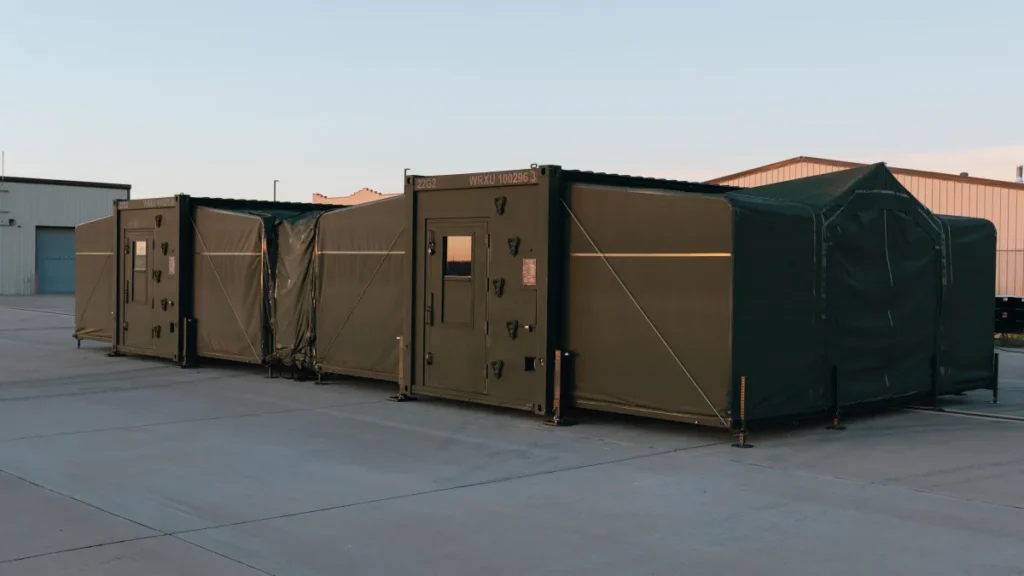

Defense tech keeps getting weirder and more interesting. Firestorm Labs just closed an $82 million round to do something that sounds like sci-fi: put a drone factory inside a standard shipping container and ship it directly to the battlefield.
The idea isn’t just about making drones faster. It’s about making them where they’re actually needed, cutting out weeks of supply chain lag. If a unit needs a specific variant of reconnaissance drone with different sensors or payloads, the factory container gets trucked or airlifted to a forward operating base, and within days you’ve got fresh hardware rolling off the line.
Firestorm’s whole pitch is that traditional defense manufacturing is too centralized. You build everything in a handful of factories in the US, then spend weeks or months shipping finished products around the world. By the time they arrive, the threat has evolved. Their containerized approach flips that model: bring the factory to the fight, iterate on the design based on real-time intel, and produce what’s actually needed right now.
The $82M Series B was led by some heavy hitters in the defense VC space, though Firestorm hasn’t named all the participants yet. What they have said is that the money will go toward scaling production of their existing drone platforms and, more importantly, deploying those container factories in the field for real military customers.
I’ve seen this concept tried before in various forms. A few years back, there were experiments with mobile 3D printing rigs for spare parts on Navy ships. But Firestorm is taking it further by building an entire production line—assembly, testing, quality control—inside a 40-foot box. That’s a lot of engineering to cram into a space that normally holds sneakers or frozen fish.
The drones themselves are small tactical UAVs, not Reaper-sized beasts. Think hand-launched or catapult-launched platforms that can loiter for an hour or two, carry day/night cameras, and relay data back to troops. Nothing revolutionary on the airframe side, but the manufacturing model is the real differentiator.
One thing that gives me pause: logistics. A container factory still needs raw materials, components, and skilled operators. If you’re deploying these to a contested environment, you’re also creating a high-value target. Shipping containers aren’t exactly stealthy. Firestorm will need to prove they can keep the supply chain flowing and the factory secure under real combat conditions.
Still, the DoD has been pushing for more distributed manufacturing for years. Programs like the Replicator initiative explicitly call for faster, cheaper, and more adaptable production. Firestorm seems to be betting that the container model is the answer, and with $82M in fresh funding, they’ve got the runway to find out.
I’ll be watching to see if they can actually deliver on the promise of “drones in days, not years.” If they do, this could change how we think about defense logistics. If they don’t, it’ll be another cautionary tale about overpromising on battlefield tech.
Comments (0)
Login Log in to comment.
Be the first to comment!