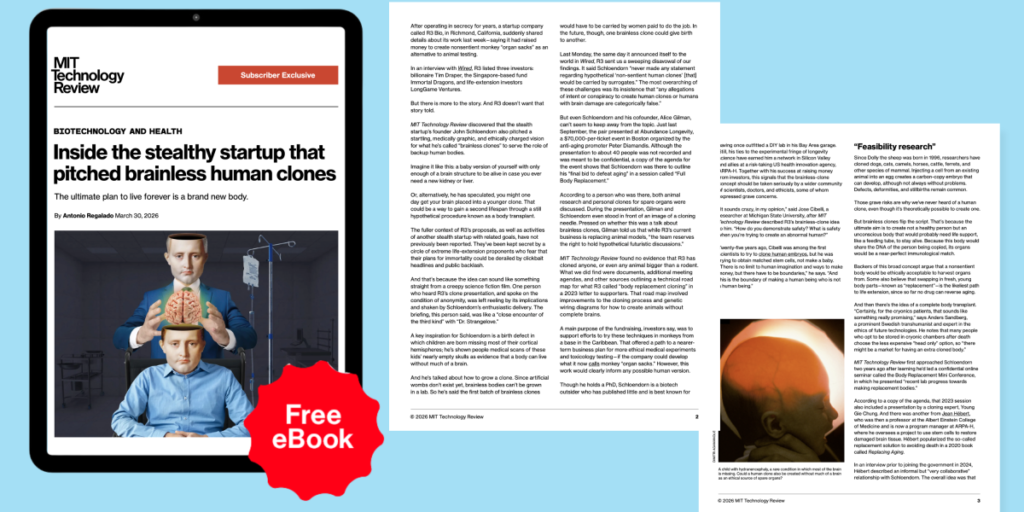

MIT Technology Review just dropped an exclusive eBook that reads like a sci-fi pitch meeting gone real. It’s called “Inside the stealthy startup that pitched brainless human clones,” and it’s about R3 Bio — a tiny company with an absolutely enormous and deeply weird ambition: grow human clones without brains, then keep them around as spare bodies.
The ultimate plan to live forever, they argue, is a brand new body. Not cryonics, not digital uploads, not some consciousness-transfer pipe dream. Just a clean, blank, brainless clone of yourself, ready to be occupied when the original wears out.
I have to admit, I clicked on this expecting pure hype. But Antonio Regalado, who wrote the thing, has a track record of not pulling punches when the science gets shaky or the ethics get slippery. And based on the excerpt and related stories — including one about a researcher who wants to replace your brain “little by little” — this is not your typical tech utopian fluff.
R3 Bio’s pitch is startling and ethically charged, to put it mildly. The idea of growing a human organism that is genetically identical to you but lacks a brain — and therefore any semblance of consciousness or capacity for suffering — raises questions that most biotech investors probably don’t want to touch with a ten-foot pipette. Is it a person? Is it a product? Is it a medical device? The regulatory landscape for something like this is basically a blank map.
Let’s be real for a second: the science required to pull this off is nowhere near ready. Growing a full human body without a brain isn’t just difficult — it’s something we have no idea how to do. We can barely grow organoids in a dish. The gap between today’s stem-cell biology and a fully formed, brainless human clone is the kind of gap that swallows careers and companies whole.
But that’s exactly what makes this eBook worth your time. It’s not about whether R3 Bio will succeed — odds are they won’t. It’s about the fact that someone is actually trying, and that the conversation around human cloning, consciousness, and bodily autonomy is no longer theoretical. It’s happening in a startup office somewhere, probably with bad coffee and a whiteboard full of ethical landmines.
The eBook is subscriber-only, which is a bit of a bummer, but MIT Tech Review has been putting out solid deep dives on biotech for years. If you’re already a subscriber, grab it. If you’re not, the related stories are worth a read — especially the one about gradual brain replacement, which is somehow even weirder than the clone idea.
Either way, this is the kind of reporting we need more of: digging into the fringe, asking hard questions, and not pretending the answers are easy. Because the future isn’t going to arrive with a press release. It’s going to show up in a stealthy startup with a pitch that makes you uncomfortable.
Comments (0)
Login Log in to comment.
Be the first to comment!