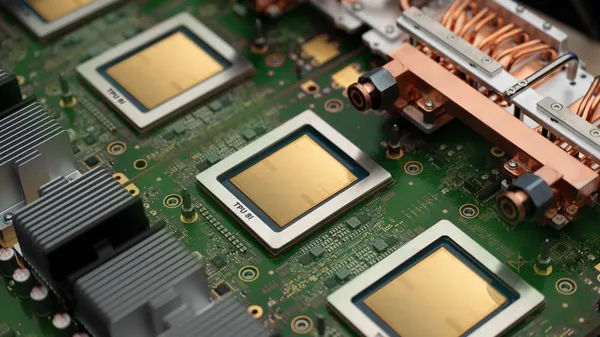

Google just dropped the eighth generation of its TPU family, and for the first time, they’re not just iterating on a single design. They’re splitting the lineup into two distinct chips, each tuned for a different phase of the AI workload.
That’s a big deal. Up until now, TPUs have been general-purpose accelerators for training and inference. You threw models at them, they crunched numbers, and that was that. But the agentic era—where models don’t just answer questions but plan, reason, and execute multi-step tasks—changes the compute profile entirely.
The Two Chips
The first chip, which I’ll call the “reasoning” TPU (Google hasn’t officially branded them this way, but it’s how they’re positioning it), is optimized for the heavy lifting: chain-of-thought prompting, tool use, and the kind of iterative thinking that agents need. It has a larger on-chip memory footprint and higher bandwidth to handle the intermediate state that accumulates during multi-step reasoning.
The second chip is a serving TPU, leaner and meaner for high-throughput inference. Think of it as the workhorse that takes the final output of a reasoning chain and delivers it to users at scale. Lower latency per request, better power efficiency for production deployments.
This split mirrors what I’ve been seeing in the industry for the past year. Anthropic, OpenAI, and even open-source projects like LangChain are all pushing toward agentic loops where a model might call a search API, read a database, then rewrite a response. That’s not a single forward pass anymore—it’s a graph of operations. Google’s bet is that you need specialized silicon to do this efficiently.
Why This Matters
The obvious question is: why not just use a single, more powerful TPU for everything? Because the cost and power curves don’t work. A reasoning chip that’s great at holding large intermediate states is overkill for a simple chat completion. And a serving chip that’s optimized for low latency would choke on a 10-step reasoning chain. Splitting the workload lets you match hardware to the job, which is exactly what hyperscalers have been doing with CPUs and GPUs for decades.
Google’s timing is interesting. They’re launching this just as the hype around “agents” is peaking, but also as skepticism grows about whether current hardware can handle the complexity. I’ve run agentic workflows on NVIDIA H100s, and the memory bottlenecks are real. A TPU with dedicated support for stateful reasoning could be a genuine differentiator.
The Catch
Of course, Google isn’t selling these chips directly—they’ll be available through Google Cloud, likely with the usual opaque pricing and reserved capacity models. If you’re a startup building an agent platform, you’re tying your infrastructure to Google’s ecosystem. That’s fine if you’re already on GCP, but less appealing if you want multi-cloud flexibility.
Also, no word on whether these TPUs support the kind of dynamic batching that agentic workloads require. Agent loops are unpredictable—sometimes a step takes 100ms, sometimes 2 seconds. Traditional batching assumes uniform latency. Google hasn’t shown how they handle that variance.
Still, this is the most interesting TPU announcement in years. Google is betting that the future of AI isn’t just bigger models, but smarter, more interactive systems. And they’re building the hardware to match.
Comments (0)
Login Log in to comment.
Be the first to comment!