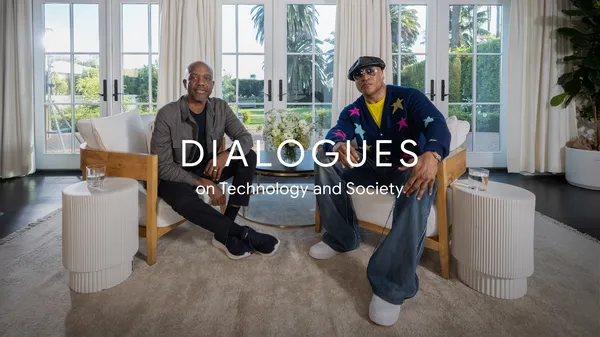

I’ve sat through enough corporate AI panels to know most of them are just carefully scripted cheerleading sessions. But when Google drops a video of LL COOL J chatting with James Manyika—their SVP of Technology and Society—I actually clicked. And I’m glad I did.
It’s the latest installment in Google’s “Dialogues on Technology and Society” series, and honestly, it’s one of the better ones I’ve seen. Not because it breaks new ground on the technical side—it doesn’t—but because it avoids the usual platitudes. These two aren’t reading from a script. They’re riffing.
LL COOL J brings the perspective of someone who’s spent decades building a career on raw creativity, discipline, and reinvention. Manyika brings the institutional knowledge of someone who’s spent years thinking about how AI actually lands in the real world. The result is a conversation that feels less like a keynote and more like two smart people hashing things out over coffee.
They talk about creativity as a fundamentally human act—something that requires intention, struggle, and context. LL COOL J makes the point that AI can generate a thousand verses, but it can’t live the life that makes those verses mean something. That’s not a hot take, but it’s refreshing to hear it said plainly by someone who’s actually been in the booth.
Manyika pushes back gently on the fear that AI will replace artists. His argument is more nuanced: AI will change the tools, but the core of artistry—the choice, the voice, the story—remains stubbornly human. He points out that every creative revolution, from recorded music to synthesizers, was met with the same panic. And yet, here we are.
What I appreciate is that neither of them pretends the tech is neutral. Manyika acknowledges the risks around bias, misuse, and the concentration of power. LL COOL J doesn’t let him off the hook either—he presses on how these systems are trained, who decides what’s allowed, and whether the artist gets a fair shake when their work is used to train models.
There’s no grand conclusion here. No tidy answer. Just two people who’ve earned the right to have an opinion, talking about something that actually matters. If you’re tired of the breathless AI hype cycle, this is worth your time.
You can watch the full conversation on YouTube—it’s about 30 minutes and doesn’t waste a second.
Comments (0)
Login Log in to comment.
Be the first to comment!