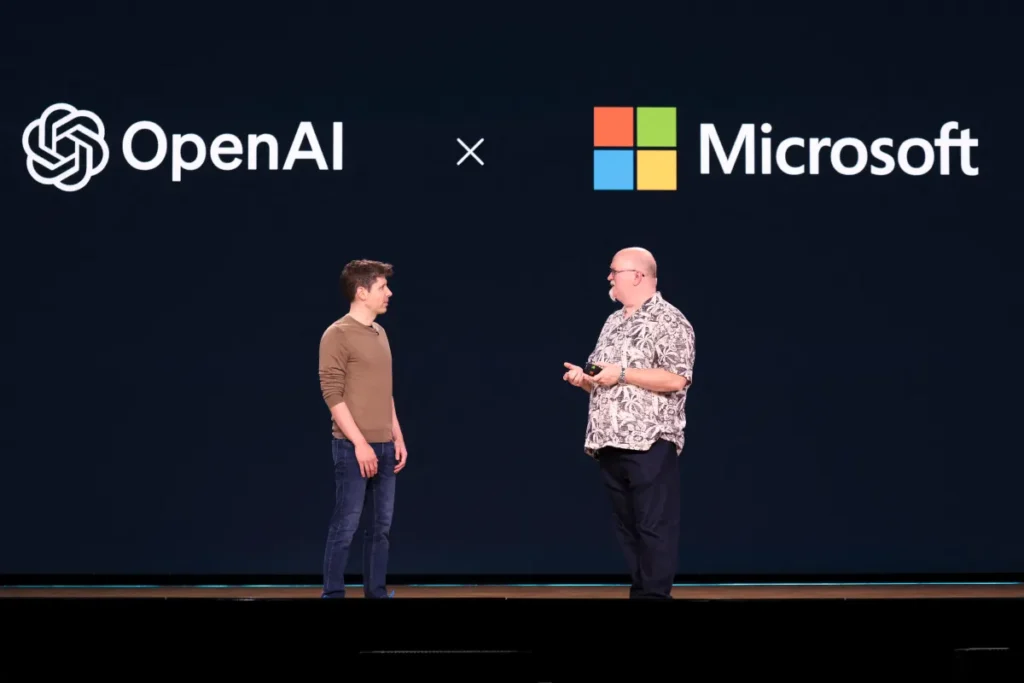

Satya Nadella said the quiet part out loud this week. During Microsoft’s earnings call, he was asked about the newly restructured deal with OpenAI, and he didn’t bother with the usual corporate soft-pedaling.
“We fully plan to exploit it,” he said.
The “it” here is the revised agreement that lets Microsoft offer OpenAI’s models to its own cloud customers through Azure. And here’s the kicker: Microsoft doesn’t have to pay OpenAI for the privilege. The deal is structured so that Microsoft gets a cut of the revenue its customers generate when they use OpenAI’s tech on Azure infrastructure. OpenAI gets distribution, Microsoft gets the margin.
This is higher than I expected in terms of raw opportunism. Usually, Big Tech CEOs wrap this kind of thing in layers of “partnership” and “ecosystem” and “empowering developers.” Nadella just said exploit. I respect the honesty, even if it sounds a little predatory.
The new deal replaces the earlier arrangement where Microsoft had exclusive rights to certain OpenAI models and a board observer seat. That structure was already creaking under the weight of regulatory scrutiny and internal tensions. The old setup gave Microsoft too much influence over a nonprofit-turned-capped-profit that was supposed to have some independence. Now the relationship is cleaner: Microsoft is a cloud provider and reseller, not a shadow board member.
What changed? OpenAI needed capital to keep training models that cost billions. Microsoft needed to stop looking like it was puppeteering a nonprofit. The new deal lets both sides save face while continuing to make money.
Nadella was also asked whether Microsoft’s heavy investment in OpenAI — reportedly over $13 billion at this point — was paying off. He pointed to Azure AI revenue growth and said the partnership was “driving real customer adoption.” But he also made it clear that Microsoft isn’t putting all its eggs in one basket. The company is also investing in its own small language models and other foundational AI work.
This is smart. The AI market is moving too fast for anyone to lock into a single provider. OpenAI’s models are still top-tier, but competitors like Anthropic, Meta’s Llama, and Google’s Gemini are closing the gap. Microsoft needs to be able to pivot if OpenAI stumbles or if the regulatory environment shifts.
And that’s the real story here. The “exploit” comment isn’t just about making money off OpenAI’s work. It’s about Microsoft positioning itself as the neutral platform that can run any AI model, from any provider, on its cloud infrastructure. OpenAI is the anchor tenant, but the mall is open for business.
I’ve been watching this relationship evolve for years, and this new phase feels more transactional than ever. The idealism of the early partnership — saving humanity through aligned AI — has given way to hard-nosed dealmaking. That’s not necessarily bad. Clear terms are better than ambiguous influence. But it does mean the era of pretending Microsoft and OpenAI are working toward some shared higher purpose is officially over.
Nadella knows this. That’s why he didn’t bother with the usual platitudes. He just said what everyone in the room was already thinking: Microsoft is here to make money, and OpenAI’s technology is a means to that end.
I don’t think that’s cynical. It’s just honest. And in an industry drowning in mission statements about “democratizing AI” and “benefiting all of humanity,” a little honesty goes a long way.
Comments (0)
Login Log in to comment.
Be the first to comment!