
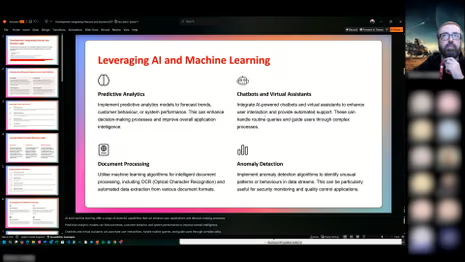
There’s a video going around from a lecture at Staffordshire University that captures something a lot of students are feeling right now. A guy named James stands up and tells the lecturer to scrap the slides because he knows they’re AI-generated. “I do not want to be taught by GPT,” he says. The lecturer laughs uncomfortably and changes the subject.
James and Owen were among 41 students who signed up for a coding module last year, part of a government-funded apprenticeship program aimed at helping people switch careers into cybersecurity or software engineering. They were hoping for a real education. What they got was AI-generated slides read by an AI voiceover that occasionally switched accents mid-sentence — from British to Spanish for 30 seconds and back again. The file names were suspicious. The content was generic. At one point the material referenced US legislation for no reason.
“If we handed in stuff that was AI-generated, we would be kicked out of the uni, but we’re being taught by an AI,” James said during that confrontation, which was recorded as part of the course in October 2024.
The university’s response? They basically told the student representative that “teachers are allowed to use a variety of tools.” And then they went further — this year they posted a policy statement on the course website that appears to justify using AI to generate teaching materials. It lays out “a framework for academic professionals leveraging AI automation” in scholarly work and teaching. Meanwhile, the university’s public-facing policies still say students who outsource work to AI are breaching integrity rules and could face misconduct charges. So it’s one rule for them, another for the students.
James is in his mid-life, trying to restart his career. “I don’t feel like I can now just go away and do another career restart. I’m stuck with this course,” he said. That’s the real cost here. These aren’t 18-year-olds fresh out of high school. These are adults who took a gamble on a program that was supposed to change their lives, and they feel like they’ve “used up two years” on something done “in the cheapest way possible.”
The Guardian reviewed the course materials and ran them through two AI detectors — Winston AI and Originality AI. Both flagged a “very high likelihood” that the assignments and presentations were AI-generated.
This isn’t an isolated incident. A survey by Jisc, an educational technology firm, found that nearly a quarter of higher education teaching staff were using AI tools in their teaching. The UK’s Department of Education released a policy paper in August that practically cheered this on, saying generative AI “has the power to transform education.” Students in the US are posting negative reviews about professors who use AI. On Reddit, UK undergraduates complain about lecturers copying and pasting ChatGPT feedback or using AI-generated images in courses.
One student on Reddit summed it up: “I understand the pressures on lecturers right now that may force them to use AI, it just feels disheartening.”
I get the pressures. Universities are underfunded, lecturers are overworked, and AI tools can save time. But there’s a difference between using AI to help prepare a lesson and using it to replace the teaching entirely. When the “lecturer” is just playing an AI-generated slideshow with a robot voice, what exactly are students paying for? The degree? The networking? The piece of paper at the end?
Another student in that recorded lecture said something that stuck with me: “There are some useful things in the presentation. But it’s like, 5% is useful nuggets, and a lot is repetition. There is some gold in the bottom of this pan. But presumably we could get the gold ourselves, by asking ChatGPT.”
That’s the core problem. If the material is so generic that students could generate it themselves, then the university isn’t providing value. It’s just a middleman taking government money and student time.
The lecturer in the video eventually admitted he made another tutorial using ChatGPT. “I’ve done this short notice, to be honest,” he said. That honesty is refreshing, but it also reveals the rot. This isn’t a carefully considered pedagogical shift. It’s corner-cutting under the guise of innovation.
Staffordshire University isn’t alone, but they’re the ones who got caught on camera. And the students are right to be angry. They’re not Luddites — they’re people who want to learn actual skills from actual humans. That shouldn’t be too much to ask.
Comments (0)
Login Log in to comment.
Be the first to comment!