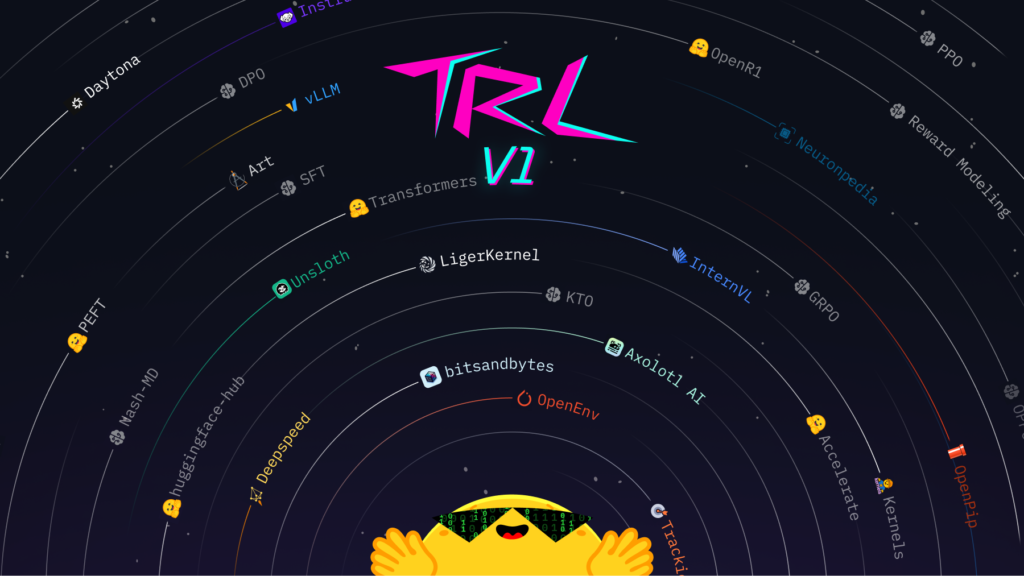

TRL v1.0 is out, and the Hugging Face team is calling it a real shift in what this library is. I’ve been watching this project since its early days, and I have to say: they’re not wrong. What started as a research codebase—the kind where you’d find half-baked experiments and TODO comments in the margins—has become something people actually build production systems on.
That’s a big deal. And it’s not just a version number bump. The library now implements over 75 post-training methods, but that’s not the interesting part. What’s interesting is how they got there without the whole thing collapsing under its own weight.
The field won’t sit still
Post-training has been a moving target from day one. We started with PPO—policy, reference model, learned reward model, sampled rollouts, RL loop. That looked like the canonical architecture for a while. Then DPO came along and said “actually, you don’t need half of that stuff.” No reward model, no value model, no online RL. Suddenly components that seemed fundamental were optional.
Then GRPO and the RLVR methods shifted everything again. Now rewards come from verifiers or deterministic checks—not learned models. Sampling and rollouts matter again, but the objects in the loop aren’t the same ones PPO libraries were designed around.
The lesson here isn’t just that methods change. It’s that the definition of what’s core keeps changing. Strong assumptions have a short half-life in this field. And that’s probably why no post-training library is really stable yet—including TRL.
Design for chaos
So how do you build a library for a field that won’t sit still? The counterintuitive answer: don’t try to capture what’s stable today. Design around what could change.
Reward models are a perfect example. They looked essential in PPO, became optional in DPO, and came back as verifiers in RLVR methods—structures that could be deterministic functions rather than learned models. Any abstraction built around their original form would have been obsolete twice over by now.
TRL’s design reflects this reality. The codebase has been shaped by six years of iteration—the first commit goes back more than six years—and every new algorithm, model, or paradigm has left its mark. Parts of it might look unusual at first, but like in many evolutionary codebases, they exist for a reason.
From code to contract
Here’s the thing: TRL didn’t make a deliberate decision to become a library. It found out it already was one. Projects like Unsloth and Axolotl—with thousands of users between them—had built directly on top of TRL’s trainers and APIs. A breaking change in TRL propagated instantly into their stacks. A renamed argument, a shifted default, a restructured output—any of these became someone else’s incident.
The shift had already happened. v1.0 is just the moment TRL acknowledged it explicitly.
And that’s a big responsibility. TRL is downloaded 3 million times a month. Major downstream projects treat it as stable infrastructure. The field keeps shifting the ground, and at the same time, those users need things not to break.
Stable and experimental, under the same roof
The unusual thing about TRL’s stability model is not what it guarantees—it’s what it tolerates alongside those guarantees. Stable and experimental coexist within the same package, with explicitly different contracts.
The stable core follows semantic versioning. The experimental layer makes no such promises—it’s where new methods land while they’re still being evaluated, and where the API can move fast to keep up with the field.
This isn’t a compromise. It’s a response to a specific constraint: the field produces new methods faster than any of them can earn stability. Refusing to add immature methods would make TRL irrelevant within months. Adding them all to stable would break every downstream project every time an algorithm turned out not to work as expected.
from trl import SFTTrainer
from trl.experimental.orpo import ORPOTrainer
Promotion from experimental to stable isn’t automatic. What matters is the ratio between maintenance cost and actual usage. Some methods earn their place because the community uses them heavily. Others become viable because the team can make them cheap enough to maintain—and the design of the codebase is what makes that possible.
In practice, the stable surface includes trainers for SFT, DPO, Reward modeling, RLOO, and GRPO, along with their close variants. The experimental surface is broader and moves faster.
Why this matters
I’ve seen a lot of libraries try to solve this problem. Most fail because they either ossify too early—locking in assumptions that get invalidated—or they stay too fluid and never become something you can build on.
TRL v1.0 isn’t perfect. The experimental/stable split creates confusion for new users, and the documentation still has gaps. But it’s honest about the constraints of the field. It admits that we don’t know what post-training will look like in two years, and it builds for that uncertainty rather than pretending it doesn’t exist.
That’s refreshing. And it’s probably why TRL has survived where other post-training libraries have faded.
If you’re building production systems on top of post-training, TRL v1.0 is worth a serious look. Just don’t expect it to stay the same for long. That’s the point.
Comments (0)
Login Log in to comment.
Be the first to comment!