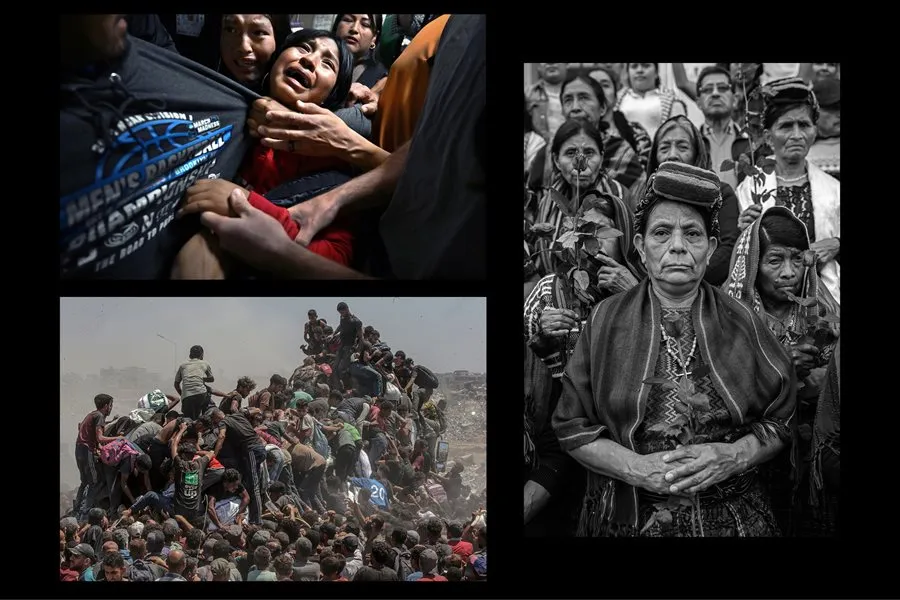

The Verge has been chewing on this question for a while now, and honestly, so has everyone I know who picks up a camera: with generative AI flooding every corner of the internet, what the hell counts as a “real” photo anymore?
The World Press Photo competition just dropped their answer, and it’s not a theoretical one. It’s a hard, fast rulebook.
The 2026 winner was announced yesterday, and it’s a gut-punch of an image. “Separated by ICE,” shot by Carol Guzy, shows children clinging to their father after an immigration hearing. It’s the kind of frame that reminds you why photojournalism exists in the first place. No prompts, no generation, no inpainting. Just a moment, captured.
But the real story here isn’t just the winning photo. It’s the rules the organization laid down to let that photo compete.
The World Press Photo foundation is an independent nonprofit, and they’ve been quietly drawing a line in the sand. Their rules explicitly ban the use of generative AI tools to create or alter the content of an image. You can’t use something like Midjourney to fake a scene, and you can’t use Photoshop’s generative fill to remove a person or object from a frame. The competition is built on the idea that the photographer was there, in that room, at that moment.
This is a higher bar than most newsrooms I’ve seen. A lot of publications still have vague policies like “AI should be used ethically” or “AI should not mislead.” The World Press Photo folks just said: don’t use it. Period. For photojournalism, that’s the only sane approach.
I’ve been watching this space for years, and I’ve seen the arguments. Some people say that AI is just another tool, like dodging and burning in the darkroom. But that’s a false equivalence. Dodging and burning changes exposure, not reality. Generative AI can fabricate people, places, and events that never existed. If you’re documenting the news, you can’t have that.
Carol Guzy’s photo is a reminder of what’s at stake. The image is raw, emotional, and real. You can see the fear in the children’s faces, the tension in the father’s posture. No algorithm could invent that. And honestly, no algorithm should try.
The contest’s stance is a clear signal to the industry. If you want to be taken seriously as a photojournalist, you need to leave the generative tools at home. This is going to create a split, I think. You’ll have the fine art world, where AI is increasingly accepted, and the documentary world, where it’s a hard no. And that’s fine. They serve different purposes.
I just hope the rest of the media pays attention. Because if we can’t agree on what a photograph is, we can’t agree on what’s real. And that’s a dangerous place to be.
Comments (0)
Login Log in to comment.
Be the first to comment!